
Implementation Snags Case Study-A Fishbone Diagram Rescues a Floundering Initiative
Even the best-planned initiatives hit snags once implementation begins. When a school's new assessment tools for complex competencies started to stall, the Head of School turned to a simple, visual strategy to surface what was getting in the way and move the team toward solutions. Here's how the Fishbone Diagram helped one leadership team get back on course in a single 90-minute meeting.
The Scenario
The strategic plan was finished. Action plans were written, complete with timelines, responsibilities, and deliverables. One of the school's major initiatives was already underway: new assessment tools designed to measure complex competencies such as collaboration, ethical action, critical thinking, and learner agency, the skills students need to thrive in the future.
But several months into the school year, the leadership team (LT) was hitting obstacles in execution.
Julie, the Head of School, decided to devote time at the next LT meeting to hearing what was causing the snags. She wanted to be sure every voice was heard and that the team could make adjustments early.

The Strategy
To plan the agenda, Julie chose the Fishbone Diagram, a strategy for identifying causes and sorting them into categories. Ahead of the meeting, she wrote "Implementation Snags" at the head of a fish template. She sent the agenda out several days early so the team could reflect on one question: What issues are standing in the way of our complex competencies’ initiative succeeding?
At the meeting, she projected the fish template on the wall and served as both facilitator and recorder, inviting LT members to name the reasons implementation was floundering. The team identified:
Staff disinterest
Lack of a common language
Time
Multiple competing priorities
Differing expectations across divisions
Better resources
Julie then asked the group to add detail along each bone of the fish. Under "lack of a common language," for example, the team noted that the rubrics were divisional, so they lacked school-wide coherence.
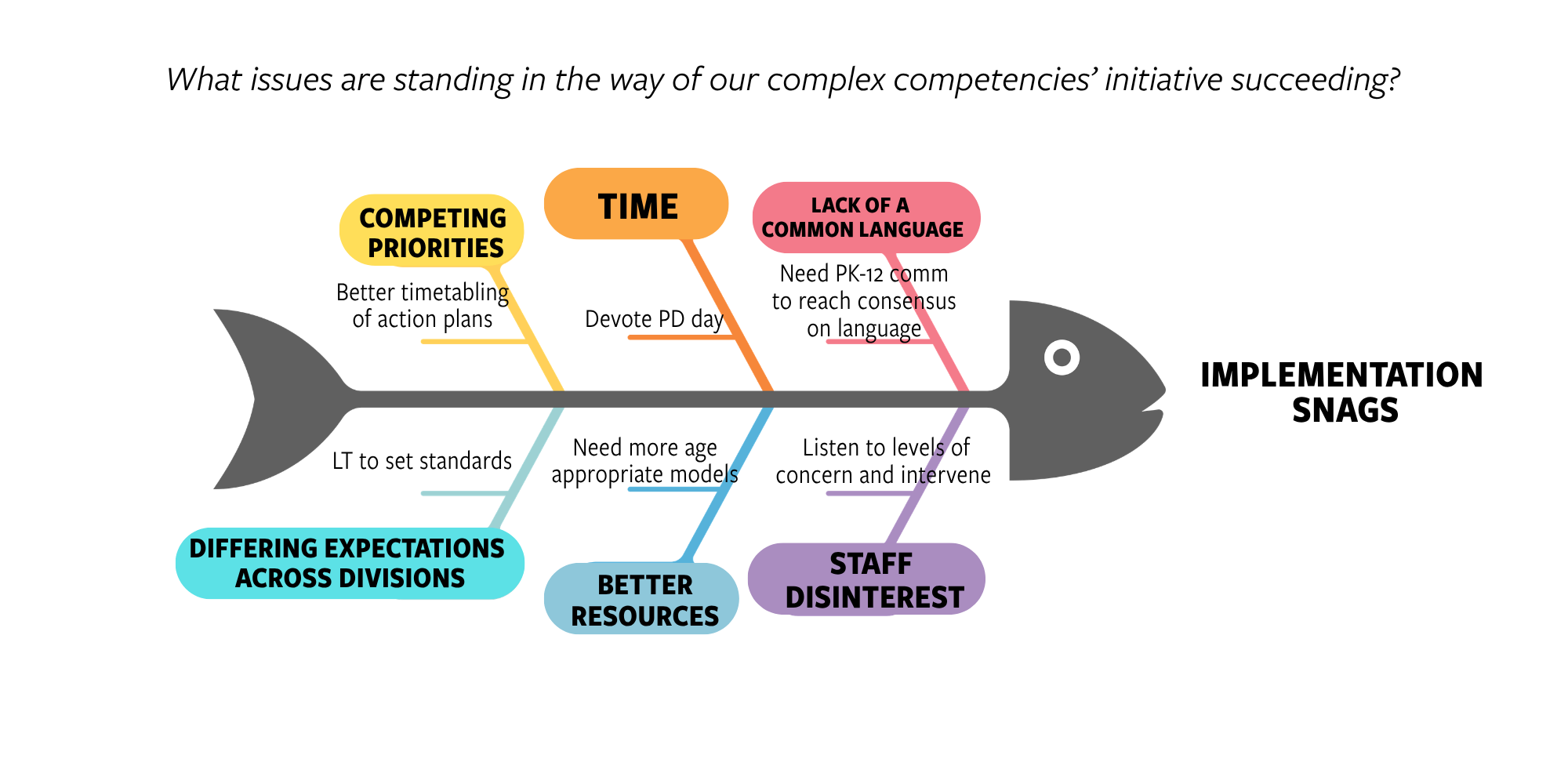
With the completed diagram in view, Julie asked which issues were most significant. The conversation that followed led the team to circle the top three.
Julie then divided the LT into three mixed groups. Each group took one of the top issues and developed both short-term and long-term fixes, then presented its ideas to the full team for discussion.
The Payoff
After that discussion, the team was ready to pinpoint the ideas with the greatest potential to address their challenges, and members quickly volunteered for the actions needed. Julie planned to refine the list and bring it back the following week for the team to finalize the details.
Julie was relieved that she had devoted a 90-minute meeting to solving problems early in implementation. She found the Fishbone Diagram structured, visual, and effective at capturing the collective knowledge of the group.
As Kim C., nonprofit leader said, “I use them (Strategy Cards) to support groups in having meaningful conversation that leads to purposeful outcomes.”
Order Strategy Cards now to move your team and organization forward.
